Just heard it in the news - they decided not to explode the remains of the flyover bridge collapsed yesterday, here, in the city where I live. Thank God they wouldn't. Because they haven't manage to build it in the first place. With all their industrial-grade materials and world-class technologies, the thing crashed two months before it was supposed to be opened. Can you imagine what happens if they use world-class explosives ? Stop doing what you know not how to do, will you ?
Same thing happens in software and it makes me sick. Guess what ? Technologies and products are worth nothing unless you actually know how to build stuff. You have to actually get to it and do it over and again before you know how to do it. If you decide to use explosives to bring a building down, you'd better be damn proficient in exactly that sort of things. If all you previously have done was paving the roads, but you occasionally have a pack of industrial-grade high explosives, your attempts to follow world-class procedures in demolition will likely go down in flames.
The worst mistake of all when you want to build quality stuff is that everything is simple. No damn it, it's not. It's damn hard. You have to know ins and outs and you have to learn by your own mistakes, and never assume that bying Oracle will solve all your application performance problems.
September 05, 2006

September 02, 2006
Experience is the name ...
About this quote by Oscar Wilde:
I thought it had an interesting language twist to it. Although the apparent interpretation suggests that everyone is hiding their mistakes behind the word "experience", there is another way of looking at it:
Experience is the name everyone gives to their mistakes
I thought it had an interesting language twist to it. Although the apparent interpretation suggests that everyone is hiding their mistakes behind the word "experience", there is another way of looking at it:
Experience is the name everyone gives to their mistakesso that it means that everyone finds a name for their mistakes, and that name becomes the experience. Thus by picking good or bad word for referring to their mistakes, everyone can totally change the way they perceive their experience.
August 25, 2006
All systems are real-time and need extra processing power
Real-time systems have much hype on them and as always need a special form of speech to cover the shortcuts. In case of real-time such speech is about "soft real-time".
The problem is - "hard real-time systems" (the ones that ALWAYS meet execution deadlines) are fiendishly difficult to build, especially on the mainstream hardware, using mainstream practices, for any kind of realistic load.
"Soft real-time" systems are thus not required to always meet execution deadlines, but rather have a probabilistic process imposed on them. Yes, it's bad if you fail to react in time, but it's still better if you react 3 ms late 40% of time than 10 ms late 10% of time (depends on the application of course).
But then, aren't all systems real-time ? After all, noone needs a system which never finishes processing, and it's better doing it sooner than later. Systems may have more or less relaxed requirements, but it's the same probabilistic process, for example 90% of users would wait 5 seconds for a transaction to complete, but only 10% wouldn't be calling tech support upon a 30 seconds delay.
Look closely at the word "real-time" itself. Everything is executed in real time, all processes have references to time flowing by, executions have starts and stops and whether or not they've been a success is determined by an external entity (a user in most cases) and timing is not the last criteria.
Anyhow, I'd like to point out one other thing. There is this theorem which says that for a real-time system to meet its deadlines under certain conditions, it must have a significant fraction of CPU processing power free. If I remember correctly, the exact top load percentage is around 70%, which means that if the CPU is busy more than that, the system starts missing deadlines.
If this result is blindly (or philosophically) applied to all the systems, it leads to an interesting conclusion - no system should be functioning under stress load (perhaps above the mentioned 70% CPU), otherwise it starts slipping behind the schedule and, being real-time, degrades its service significantly.
It would thus be a mistake to believe that an application quality of service would remain steady across all of the CPU load scale. Instead, as CPU usage climbs up to 70%, the application may scale perfectly linearly, but as the load keeps rising, the scaling breaks. It's therefore more safe to consider 70% to be the top acceptable load and start adding more processing power as this line is crossed.
The problem is - "hard real-time systems" (the ones that ALWAYS meet execution deadlines) are fiendishly difficult to build, especially on the mainstream hardware, using mainstream practices, for any kind of realistic load.
"Soft real-time" systems are thus not required to always meet execution deadlines, but rather have a probabilistic process imposed on them. Yes, it's bad if you fail to react in time, but it's still better if you react 3 ms late 40% of time than 10 ms late 10% of time (depends on the application of course).
But then, aren't all systems real-time ? After all, noone needs a system which never finishes processing, and it's better doing it sooner than later. Systems may have more or less relaxed requirements, but it's the same probabilistic process, for example 90% of users would wait 5 seconds for a transaction to complete, but only 10% wouldn't be calling tech support upon a 30 seconds delay.
Look closely at the word "real-time" itself. Everything is executed in real time, all processes have references to time flowing by, executions have starts and stops and whether or not they've been a success is determined by an external entity (a user in most cases) and timing is not the last criteria.
Anyhow, I'd like to point out one other thing. There is this theorem which says that for a real-time system to meet its deadlines under certain conditions, it must have a significant fraction of CPU processing power free. If I remember correctly, the exact top load percentage is around 70%, which means that if the CPU is busy more than that, the system starts missing deadlines.
If this result is blindly (or philosophically) applied to all the systems, it leads to an interesting conclusion - no system should be functioning under stress load (perhaps above the mentioned 70% CPU), otherwise it starts slipping behind the schedule and, being real-time, degrades its service significantly.
It would thus be a mistake to believe that an application quality of service would remain steady across all of the CPU load scale. Instead, as CPU usage climbs up to 70%, the application may scale perfectly linearly, but as the load keeps rising, the scaling breaks. It's therefore more safe to consider 70% to be the top acceptable load and start adding more processing power as this line is crossed.
July 30, 2006
Re: The "Snakes on a Plane" Problem
Found an interesting article on Reddit:
The "Snakes on a Plane" Problem
Quote:
The "Snakes on a Plane" Problem
Quote:
I worked in newspapers for eight years, right when that industry was starting to disintegrate. As such, we spent a lot of time talking with focus groups, forever trying to figure out what readers wanted. And here is what they wanted: everything. [...] When it comes to mass media, it's useless to ask people what they want; nobody knows what they want until they have it.Why this sounds all so familiar ?
July 27, 2006
One other reason why new software is released
Because the users keep using the old one in the wrong way.
July 24, 2006
Reusable business-specific abstraction is an oxymoron
In this article I'd like to talk about abstractions in software development, focusing specifically on business-specific reuse.
Abstractions come in many flavours. At the most general level, abstraction is the single most valuable method of analysis. Mathematics is all about it. Abstraction is also the result of that analysis. I will be using the term "abstraction" as if it meant "a concept relevant in particular context". In simple terms abstraction is "something that ..."
In programming, abstractions appear in many places. It's impossible to discuss all of them, so here is a few random examples before we proceed to the points of the discussion.
The simplest abstraction in programming is the byte. The concept of byte suggests that (1) all data we manipulate with can be converted to numbers and (2) the numbers can be encoded using fixed width integers. Although bytes with size different from 8 bits have been experimented with, they were not successful (not that I saw CDC Cyber myself, but the books say so). Let's think why all the bytes have converged to 8 bits. My answer is - because there is no difference. They could have been of any size, 8 bits were just a good balance of range/processing power vs. costs to produce at that time. As the costs kept falling, the bytes actually grew (although under a name of machine word now). Anyhow, the byte became a universally accepted abstraction, reused literally everywhere.
Abstractions also appear in OOP where they hide in the shadows of the objects themselves. After all what is an object if not an abstraction of some real-world entity ? OOP is very successful in giving developers abstraction producing machinery which they apply to their problems yielding abstractions directly translatable to programming languages. Not all the created abstractions are reusable, leave alone useful, but OOP itself is.
As we can see, low level abstractions can become quite successful and widely adopted. This is because they are so "abstract" they apply everywhere out of the box, and changing them would make no difference, and so nobody even thinks about why they are there and what's their purpose. They are just there, they've always been (for an eternity of fifty years), they are the truth. Although this approach is far from scientific, it works well in production. After all, why do I need to know the details of the chemical process for producing plastic, as long as all I need is to wrap my groceries in a plastic bag ?
And so, my first point - easily reusable abstractions are invisible. We use them without ever noticing. "Why ? Of course our data is encoded in bytes, what a stupid suggestion !" Low level abstractions are such, but hardly any others, at least right now.
As we move farther towards the "real business" side of programming scale, it's increasingly difficult not to notice the abstractions arising more as obstacles than helpers. One step up, look at what building blocks we have as we build real systems. No matter if it's 1980s or 2000s, the abstractions that your programming environment offers are the same:
Two steps up, when it comes to real business, there are no abstractions. It has to be done in exact particular way. Nobody's going to use an application if it doesn't make precisely what the user wants. That's why all the software is to some degree configurable and adjustable. The rigid abstract part of the software is clearly separated from the flexible configuration part. The abstraction therefore has nothing to do with the business specifics - it's all in the configuration. And if you are lucky, you've got enough flexibility to cover everything.
Now, I'm asking you this - wouldn't then a "reusable business-specific abstraction" be an oxymoron ?
For one, "business-specific abstraction" is already nonsence. Abstract has its details stripped off and replaced with imaginary concepts. But details are the heart of the particular business, no matter if it's called "valuable proprietary know-how" or "ugly poorly understood mess". And it makes difference. And it's highly visible. If you are switching from DCOM to SOAP, nobody cares. But if you mishandle customer's data for the sake of abstraction that you might have - well, they won't approve it. It has to be done their way or no way. If your abstraction is too rigid - too bad for it.
For two, "reusable business-specific" is also nonsence, as soon as you are crossing enterprise boundaries. Unless Big Brother takes over, every single business is going to be to some extent unique and as such will not be covered by the abstraction. Even if you are borrowing a clearly separated network service, not burdened with thousand dependencies, it's likely to be useless without tweaking.
And so my second point is - business specific software can hardly be abstract and hardly reusable. In fact, the most valuable property of such software is flexibility. It has to allow easy changes, no matter what abstraction has been put in it.
That's one of the points behind the Pythomnic project - allowing developers to build network services that can to any extent be changed on the fly, without service restart and as soon as you have read this far I invite you to check it out.
Abstractions come in many flavours. At the most general level, abstraction is the single most valuable method of analysis. Mathematics is all about it. Abstraction is also the result of that analysis. I will be using the term "abstraction" as if it meant "a concept relevant in particular context". In simple terms abstraction is "something that ..."
In programming, abstractions appear in many places. It's impossible to discuss all of them, so here is a few random examples before we proceed to the points of the discussion.
The simplest abstraction in programming is the byte. The concept of byte suggests that (1) all data we manipulate with can be converted to numbers and (2) the numbers can be encoded using fixed width integers. Although bytes with size different from 8 bits have been experimented with, they were not successful (not that I saw CDC Cyber myself, but the books say so). Let's think why all the bytes have converged to 8 bits. My answer is - because there is no difference. They could have been of any size, 8 bits were just a good balance of range/processing power vs. costs to produce at that time. As the costs kept falling, the bytes actually grew (although under a name of machine word now). Anyhow, the byte became a universally accepted abstraction, reused literally everywhere.
Abstractions also appear in OOP where they hide in the shadows of the objects themselves. After all what is an object if not an abstraction of some real-world entity ? OOP is very successful in giving developers abstraction producing machinery which they apply to their problems yielding abstractions directly translatable to programming languages. Not all the created abstractions are reusable, leave alone useful, but OOP itself is.
As we can see, low level abstractions can become quite successful and widely adopted. This is because they are so "abstract" they apply everywhere out of the box, and changing them would make no difference, and so nobody even thinks about why they are there and what's their purpose. They are just there, they've always been (for an eternity of fifty years), they are the truth. Although this approach is far from scientific, it works well in production. After all, why do I need to know the details of the chemical process for producing plastic, as long as all I need is to wrap my groceries in a plastic bag ?
And so, my first point - easily reusable abstractions are invisible. We use them without ever noticing. "Why ? Of course our data is encoded in bytes, what a stupid suggestion !" Low level abstractions are such, but hardly any others, at least right now.
As we move farther towards the "real business" side of programming scale, it's increasingly difficult not to notice the abstractions arising more as obstacles than helpers. One step up, look at what building blocks we have as we build real systems. No matter if it's 1980s or 2000s, the abstractions that your programming environment offers are the same:
- User. Session. Context. Authentication with plaintext username and password (anything else is still out of reach because of interop problems).
- Database (whatever make, hard to design). Connection. Pool (not always useful). SQL query (hardly anyone knows how to write one that won't bring the server to its knees). Transactions (requires even more knowledge).
- Component framework, networking, distributed facilities, RPC, messaging (various compatibility, performance and scalability problems difficult to address).
- I18N: Encoding (Latin-1 as the mostly useful one, interop hell again).
Two steps up, when it comes to real business, there are no abstractions. It has to be done in exact particular way. Nobody's going to use an application if it doesn't make precisely what the user wants. That's why all the software is to some degree configurable and adjustable. The rigid abstract part of the software is clearly separated from the flexible configuration part. The abstraction therefore has nothing to do with the business specifics - it's all in the configuration. And if you are lucky, you've got enough flexibility to cover everything.
Now, I'm asking you this - wouldn't then a "reusable business-specific abstraction" be an oxymoron ?
For one, "business-specific abstraction" is already nonsence. Abstract has its details stripped off and replaced with imaginary concepts. But details are the heart of the particular business, no matter if it's called "valuable proprietary know-how" or "ugly poorly understood mess". And it makes difference. And it's highly visible. If you are switching from DCOM to SOAP, nobody cares. But if you mishandle customer's data for the sake of abstraction that you might have - well, they won't approve it. It has to be done their way or no way. If your abstraction is too rigid - too bad for it.
For two, "reusable business-specific" is also nonsence, as soon as you are crossing enterprise boundaries. Unless Big Brother takes over, every single business is going to be to some extent unique and as such will not be covered by the abstraction. Even if you are borrowing a clearly separated network service, not burdened with thousand dependencies, it's likely to be useless without tweaking.
And so my second point is - business specific software can hardly be abstract and hardly reusable. In fact, the most valuable property of such software is flexibility. It has to allow easy changes, no matter what abstraction has been put in it.
That's one of the points behind the Pythomnic project - allowing developers to build network services that can to any extent be changed on the fly, without service restart and as soon as you have read this far I invite you to check it out.
July 22, 2006
Always write what you really think ...
... because if your thinking is right, so will be your writing, but if your thinking is wrong, it doesn't matter what you write anyway.
July 06, 2006
Want to automate your business ? Want a single-click software ? Prepare for changes.
Very few people actually love the work they do. If it's somehow done magically with no concern of theirs, hey, they'd rather be fishing ! People have always tended to avoid work. Having somebody else to do one's job is the best strategy under the sun. Even for those who are not very sick of their job today, and pretend to be doing things, the less actual action - the better. Laziness is a much better driver than fictional pursue of productivity, urge for business success or corporate loyalty.
Now, people don't need software at all. Like I said, they need their job done, preferrably with no load on themselves. But software was giving such promises about how much easier it would be (if you purchase product X) since day one. Not that many still believe that new version of Microsoft Word will boost their productivity, but hey, this is how documents are prepared in 21st century, ain't it ? It's just that you install it, boom ! and your documents "practically manage themselves" (a ridiculous sentence if you ask me).
Therefore users dream of software with one big button reading "Get my job done now" (even then there would be some moaning about how much hassle it is to push it). It is indeed crucial to design software in such a manner that it requires as little user intervention as possible. But doing so is very tricky.
Let's say we are developing an accounting package. The first problem we are going to face is ubiquitous lack of knowledge. It probably wouldn't surprise you the least that someone with degree in CS knows nothing of accounting, leave alone specific customer's business practices. What would surprise you for the first few times is that the users themselves don't know what they are doing, no matter if they've got a degree in finance.
We are likely to see that everyone knows a little bit but nobody sees the big picture. "It's just how it's done here, that guy over there probably knows something" is the sort of speech you may hear. Blind leading the blind, at its worse.
A good business analyst can save the day, no doubt. Since a good business analyst essentially is a person to some extent trained in both areas, experienced in exactly that kind of projects and (which is crucial) clever, fluent and clear in his thoughts and talks, he could definetely talk things out.
But the business analyst will actually be busy recognizing an elephant from descriptions given by three blind wisemen. Or, sorting out all the quirks of the customer's business practices, which is essentially the same thing. Even if (and it's a big if) he succeeds all the team gets is a 10 sq. ft. diagram with lines going in all directions. Better understanding, perhaps, but of what ? And this is where the second problem hits - ugly and tangled business practices.
Well, the customer is always right and all that, but what's the point in one-to-one mapping software functions to existing business practices ? Nobody understands how it works, I see. Now you have software that automates that ! I mean, it's just outrageous. You take a can of worms, sort of peek into it, then, using whatever perfect (huh ?!) software development process, implement the automated can of worms and hand it over to the customer.
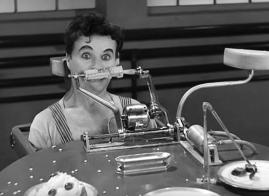
"Eeew !" - that's what the user says - "I thought this software thing would be simpler ! Where is the "Get my job done now" button ?!" Oops, there is no such button. What you get is a button for every chaotic activity you have performed before the software extravaganza started.
And so my point is - for a business to benefit from software automation, it must work well enough even before and without any software. Chaos cannot be automated, that's what I say. As there is hardly a perfectly organized business out there, well, it needs to be changed before it can be automated.
The good news is - those two processes can be performed in parallel and greatly support each other - straightening (uh, streamlining is so much a buzzword) the existing business practices, and analysis of the same for the sake of software development. If there is a perfect moment for changes, it's now - there is a lot of efforts put into it from the software developers camp, and people genuinely interested in understanding and making changes will be around, not the stupidest people too. All the customer needs is to allocate decent resources and get ready to change.
The bad news is - a customer is more likely to remain heavy and unresponsive. "There, we've paid you, now where is our button ?" Still, as you know, changes come, now or later, and it's better to change it right now than to postpone.
To conclude, I believe we as software developers should be working not just on software but also on improving our customer's business rules, it's in our own best interest. Moreover, we should be pushing the customers to changes, not just accepting their requirements.
Now, people don't need software at all. Like I said, they need their job done, preferrably with no load on themselves. But software was giving such promises about how much easier it would be (if you purchase product X) since day one. Not that many still believe that new version of Microsoft Word will boost their productivity, but hey, this is how documents are prepared in 21st century, ain't it ? It's just that you install it, boom ! and your documents "practically manage themselves" (a ridiculous sentence if you ask me).
Therefore users dream of software with one big button reading "Get my job done now" (even then there would be some moaning about how much hassle it is to push it). It is indeed crucial to design software in such a manner that it requires as little user intervention as possible. But doing so is very tricky.
Let's say we are developing an accounting package. The first problem we are going to face is ubiquitous lack of knowledge. It probably wouldn't surprise you the least that someone with degree in CS knows nothing of accounting, leave alone specific customer's business practices. What would surprise you for the first few times is that the users themselves don't know what they are doing, no matter if they've got a degree in finance.
We are likely to see that everyone knows a little bit but nobody sees the big picture. "It's just how it's done here, that guy over there probably knows something" is the sort of speech you may hear. Blind leading the blind, at its worse.
A good business analyst can save the day, no doubt. Since a good business analyst essentially is a person to some extent trained in both areas, experienced in exactly that kind of projects and (which is crucial) clever, fluent and clear in his thoughts and talks, he could definetely talk things out.
But the business analyst will actually be busy recognizing an elephant from descriptions given by three blind wisemen. Or, sorting out all the quirks of the customer's business practices, which is essentially the same thing. Even if (and it's a big if) he succeeds all the team gets is a 10 sq. ft. diagram with lines going in all directions. Better understanding, perhaps, but of what ? And this is where the second problem hits - ugly and tangled business practices.
Well, the customer is always right and all that, but what's the point in one-to-one mapping software functions to existing business practices ? Nobody understands how it works, I see. Now you have software that automates that ! I mean, it's just outrageous. You take a can of worms, sort of peek into it, then, using whatever perfect (huh ?!) software development process, implement the automated can of worms and hand it over to the customer.

"Eeew !" - that's what the user says - "I thought this software thing would be simpler ! Where is the "Get my job done now" button ?!" Oops, there is no such button. What you get is a button for every chaotic activity you have performed before the software extravaganza started.
And so my point is - for a business to benefit from software automation, it must work well enough even before and without any software. Chaos cannot be automated, that's what I say. As there is hardly a perfectly organized business out there, well, it needs to be changed before it can be automated.
The good news is - those two processes can be performed in parallel and greatly support each other - straightening (uh, streamlining is so much a buzzword) the existing business practices, and analysis of the same for the sake of software development. If there is a perfect moment for changes, it's now - there is a lot of efforts put into it from the software developers camp, and people genuinely interested in understanding and making changes will be around, not the stupidest people too. All the customer needs is to allocate decent resources and get ready to change.
The bad news is - a customer is more likely to remain heavy and unresponsive. "There, we've paid you, now where is our button ?" Still, as you know, changes come, now or later, and it's better to change it right now than to postpone.
To conclude, I believe we as software developers should be working not just on software but also on improving our customer's business rules, it's in our own best interest. Moreover, we should be pushing the customers to changes, not just accepting their requirements.
July 04, 2006
Open source, closed source, can anyone tell a good piece of software from a bad one ?
To start the discussion, let me ask you this - shall we release early and often ?
If we release early, we are likely to release crap, but have better exposure. But people are already used to software being crap. Besides, crap or not, there is no easy way for users to tell.
But if we go the long way of making the software better as we see it, and release later, the quality might be better, but it's still expected to be crap (release 1.0, anyone ?) and even though the experience might prove otherwise, the impression is still about the same. Besides, whi will care ?
Paradoxically, we are pushed towards producing crap faster.
Again, the key problem here is that we have no way of evaluating software quality. The closed source used to rely on the quality signals that, once been in favour have long since sold out - brands, advertisement, experts, reviews. The open source may rely on community judgement, popularity and zealotry, but what is it if not bandwagon effect ? Is it any better then ? I don't think so. Both sides rely on experience, but then again, experience is nothing but a way of convincing oneself.
Anyhow, my point is - open source, closed source, both parties have their reasons, politics and propaganda, both are eager to sell, but not only neither knows a way of producing high quality software, nobody can even know for sure if any given piece of software is good or not.
Think about it. We make stuff. We are proud artists (each a Picasso, no less). But when presented with somebody else's work, we cannot tell its quality. Isn't it outright ridiculous ? What kind of an industry is that ?
We thus are tackling the wrong problem. We need to build quality things. Instead we invent different ways of building things of unknown quality.
We desperately need reliable indicators of software quality.
If we release early, we are likely to release crap, but have better exposure. But people are already used to software being crap. Besides, crap or not, there is no easy way for users to tell.
But if we go the long way of making the software better as we see it, and release later, the quality might be better, but it's still expected to be crap (release 1.0, anyone ?) and even though the experience might prove otherwise, the impression is still about the same. Besides, whi will care ?
Paradoxically, we are pushed towards producing crap faster.
Again, the key problem here is that we have no way of evaluating software quality. The closed source used to rely on the quality signals that, once been in favour have long since sold out - brands, advertisement, experts, reviews. The open source may rely on community judgement, popularity and zealotry, but what is it if not bandwagon effect ? Is it any better then ? I don't think so. Both sides rely on experience, but then again, experience is nothing but a way of convincing oneself.
Anyhow, my point is - open source, closed source, both parties have their reasons, politics and propaganda, both are eager to sell, but not only neither knows a way of producing high quality software, nobody can even know for sure if any given piece of software is good or not.
Think about it. We make stuff. We are proud artists (each a Picasso, no less). But when presented with somebody else's work, we cannot tell its quality. Isn't it outright ridiculous ? What kind of an industry is that ?
We thus are tackling the wrong problem. We need to build quality things. Instead we invent different ways of building things of unknown quality.
We desperately need reliable indicators of software quality.
June 24, 2006
Perpetual movement of crap
Software is crap. All of it. Or, may be you can prove otherwise ? But I'm warning you - I'm not buying a name underneath the ®, a web-site full of buzzwords, a stellar magazine review or even a community size of China. Why not ? Because neither is reliable. Now, all the above left out, how can you make me believe it's good ?
We desperately lack means to evaluating software quality. Not just quality, but all the -ilities aka non-functional requirements. It's so bad - it's not even funny. We cannot examine the software as such, we never look at it directly, all we have is different directions from which we observe its reflections. Software is incredibly opaque - it's as if you had to evaluate an actor performance on a stage veiled by not one but many curtains. Difficult casting problem, isn't it ?
What exactly are those curtains the software is hidden behind ? I believe they are exactly the steps we take to make it - to come from an idea or perhaps a set of basic requirements to the working machine code. It looks innocent, even proud - all those philosophical aspects of OOP, applied math with its abstractiveness so profound, the development processes with metrics and iterations and so on.
But each step takes us further into the land of not understanding, and the sad truth is - our methods don't work. Somewhere on this glorious path, something slips and all we get at the end is crap. A wonderfully abstract crap. A beatifully modelled crap. A crap produced with the process tailored by developers at a CMM5 level.
And not just that. Now that we have our methods applied, it's impossible to see the thing we have been building in this pile of crap. It's shredded crap in a box - it's impossible to see through. Isn't it funny how testing speaks about black box vs. white box testing ? The box - note to yourself.
Being compared so often to the construction, software development is far worse in that it's a land of fairies - it's difficult to apply your common sense in a world where buildings can be started from their roofs and left hanging in the air.
Imagine that you are buying a house but you can't see it - it's in a box - granted a big one. All you can do is to give it tests - does the water start when you open the tap ? Yes, says the developer, it does - trust me, we have installed the tap complying with the latest industrial standards. Can I see it, you ask ? No, it's in the box, but it works ! You tap something which sort of looks like one and hear the sounds of water. Uhm, ok. Does it have windows ? Yes, sure it does. Can I see it ? No, it's in the frikin box ! How can I be sure the windows are installed in walls, not in floors or are not even left leaning to a basement wall ? Trust me on this, we are professionals here. So much for a black box house testing. Now, white box testing is not much better. When applied to houses, white box testing wouldn't mean you are allowed in to look around - instead you are allowed to look at the blueprints. Oh, now it's so much better. As a home owner I couldn't tell the mentioned tap on the blueprint. Besides, having a finest project of all still doesn't mean the windows are where they are supposed to be.
Unable to see for yourself, how do you estimate the quality of software ? You go for much less reliable sources - the talk of the people who want to sell it to you. Now, that's who you can trust - the salesmen ! Their cheap talk..., but I don't have to tell you that. The words they are using, please, don't let me start - "industrial standard" - that's my favourite... Trade shows, web site reviews, free T-shirts, it's all part of the selling game.
But think - what speaks louder than all the advertisements, and is closer to the real situation ? Hint - it literally yells in your face, sometimes several times a day, you are so used to it, you are skipping it right on the spot by clicking "Next". What is it ? It's the software license. No matter if it's a proprietary license or whatever orthodox OSI certified open source one - the most important part of it says that the people who did it have no confidence in the thing they are selling you. It comes with no guarantee for god's sake. Where else you can buy a thing and rightfully expect it not to work right out of the box ? And you can't return it for a working one, he he he...
Don't ever expect the software not to be crap. You can write it yourself (that's what I personally always prefer), but it'd still be crap, although you'd have a much better hold of it and earn experience. Besides, you can't write everything from the ground up, it's insane. You may just as well pick your software at random and then clench your teeth and stick with it through years until the fact that it's crap is so obvious that you cannot bear it any more. I've seen it a few times when a 3rd party software (complying with industrial standards, no doubt there) bought for ridiculous amounts of money left everybody engaged for a while, harder and harder, until eyes pop out and somebody decides that it needs to be replaced with another one (complying with newer industrial standards).
There is one other aspect I'd like to bring out.
It's ever so cool to proclaim that "lives depends on the software" - makes you so proud and self-assured, like hey ! the software that we write here - everybody depends on it ! We are cool ! It's an exaggeration at the very least. Lives depend on software no more than they do on Hollywood movies - yes, they want it, and there is an outrage if theaters are shut down, somebody may even get killed in a riot, but it only concerns those who actually allowed the movies to take so important place in their lifes. Likewise with the software - if your word processor crashes, there is an Internet outage, your bank's ATM network is out of service, your flight is cancelled while you are in the middle of nowhere, or even if your plane goes down due to a software malfunction - does that mean your life depends on it ? No, it's your habits, your ways, your convenience that do. What's true to the point is that despite having no real importance to anyone's life, once it's been given the right to shape the lives - the software may not stop. We are used to it - it's all around, it's uncomfortable to live without it.
And so, where does this discussion leave me as a software developer ? I build crap, nobody really needs it, but everybody sort of expects that the crap is there every time they look. And so I have to keep the crap running. I come to work every day and keep pushing the wagon full of crap so that it doesn't stop. If I'm lucky, I can take a few hours free of pushing and try to build something different, something which is either less crap, or at least a better wagon someone will have to push. Still.
Perpetual movement of crap, that's what our discipline is at its current stage of development.
We desperately lack means to evaluating software quality. Not just quality, but all the -ilities aka non-functional requirements. It's so bad - it's not even funny. We cannot examine the software as such, we never look at it directly, all we have is different directions from which we observe its reflections. Software is incredibly opaque - it's as if you had to evaluate an actor performance on a stage veiled by not one but many curtains. Difficult casting problem, isn't it ?
What exactly are those curtains the software is hidden behind ? I believe they are exactly the steps we take to make it - to come from an idea or perhaps a set of basic requirements to the working machine code. It looks innocent, even proud - all those philosophical aspects of OOP, applied math with its abstractiveness so profound, the development processes with metrics and iterations and so on.
But each step takes us further into the land of not understanding, and the sad truth is - our methods don't work. Somewhere on this glorious path, something slips and all we get at the end is crap. A wonderfully abstract crap. A beatifully modelled crap. A crap produced with the process tailored by developers at a CMM5 level.
And not just that. Now that we have our methods applied, it's impossible to see the thing we have been building in this pile of crap. It's shredded crap in a box - it's impossible to see through. Isn't it funny how testing speaks about black box vs. white box testing ? The box - note to yourself.
Being compared so often to the construction, software development is far worse in that it's a land of fairies - it's difficult to apply your common sense in a world where buildings can be started from their roofs and left hanging in the air.
Imagine that you are buying a house but you can't see it - it's in a box - granted a big one. All you can do is to give it tests - does the water start when you open the tap ? Yes, says the developer, it does - trust me, we have installed the tap complying with the latest industrial standards. Can I see it, you ask ? No, it's in the box, but it works ! You tap something which sort of looks like one and hear the sounds of water. Uhm, ok. Does it have windows ? Yes, sure it does. Can I see it ? No, it's in the frikin box ! How can I be sure the windows are installed in walls, not in floors or are not even left leaning to a basement wall ? Trust me on this, we are professionals here. So much for a black box house testing. Now, white box testing is not much better. When applied to houses, white box testing wouldn't mean you are allowed in to look around - instead you are allowed to look at the blueprints. Oh, now it's so much better. As a home owner I couldn't tell the mentioned tap on the blueprint. Besides, having a finest project of all still doesn't mean the windows are where they are supposed to be.
Unable to see for yourself, how do you estimate the quality of software ? You go for much less reliable sources - the talk of the people who want to sell it to you. Now, that's who you can trust - the salesmen ! Their cheap talk..., but I don't have to tell you that. The words they are using, please, don't let me start - "industrial standard" - that's my favourite... Trade shows, web site reviews, free T-shirts, it's all part of the selling game.
But think - what speaks louder than all the advertisements, and is closer to the real situation ? Hint - it literally yells in your face, sometimes several times a day, you are so used to it, you are skipping it right on the spot by clicking "Next". What is it ? It's the software license. No matter if it's a proprietary license or whatever orthodox OSI certified open source one - the most important part of it says that the people who did it have no confidence in the thing they are selling you. It comes with no guarantee for god's sake. Where else you can buy a thing and rightfully expect it not to work right out of the box ? And you can't return it for a working one, he he he...
Don't ever expect the software not to be crap. You can write it yourself (that's what I personally always prefer), but it'd still be crap, although you'd have a much better hold of it and earn experience. Besides, you can't write everything from the ground up, it's insane. You may just as well pick your software at random and then clench your teeth and stick with it through years until the fact that it's crap is so obvious that you cannot bear it any more. I've seen it a few times when a 3rd party software (complying with industrial standards, no doubt there) bought for ridiculous amounts of money left everybody engaged for a while, harder and harder, until eyes pop out and somebody decides that it needs to be replaced with another one (complying with newer industrial standards).
There is one other aspect I'd like to bring out.
It's ever so cool to proclaim that "lives depends on the software" - makes you so proud and self-assured, like hey ! the software that we write here - everybody depends on it ! We are cool ! It's an exaggeration at the very least. Lives depend on software no more than they do on Hollywood movies - yes, they want it, and there is an outrage if theaters are shut down, somebody may even get killed in a riot, but it only concerns those who actually allowed the movies to take so important place in their lifes. Likewise with the software - if your word processor crashes, there is an Internet outage, your bank's ATM network is out of service, your flight is cancelled while you are in the middle of nowhere, or even if your plane goes down due to a software malfunction - does that mean your life depends on it ? No, it's your habits, your ways, your convenience that do. What's true to the point is that despite having no real importance to anyone's life, once it's been given the right to shape the lives - the software may not stop. We are used to it - it's all around, it's uncomfortable to live without it.
And so, where does this discussion leave me as a software developer ? I build crap, nobody really needs it, but everybody sort of expects that the crap is there every time they look. And so I have to keep the crap running. I come to work every day and keep pushing the wagon full of crap so that it doesn't stop. If I'm lucky, I can take a few hours free of pushing and try to build something different, something which is either less crap, or at least a better wagon someone will have to push. Still.
Perpetual movement of crap, that's what our discipline is at its current stage of development.
Subscribe to:
Posts (Atom)
